WP Help Scout Docs
WP Help Scout Docs is basically Help Scout Docs on steroids. Keep reading to find out why!
I ❤️ Help Scout, but…
Help Scout is by far the most user-friendly, yet affordable customer support software out there. I’ve used it for years, and I’m not planning to stop.
But if you’re a European business owner (like me) and you’re bound to the GDPR, Help Scout’s Docs feature is a problem. You basically can’t offer your customers proper documentation without nagging them for consent first. For a FAQ. Ridiculous, right?
Did you know?
Help Scout’s Help Desk and Beacon features are GDPR compliant. However, Help Scout’s Docs knowledge base is not, when it comes to storing customer information.
And that’s not all. Your documentation lives on a separate site, with an outdated layout you can barely customize. It doesn’t look like the rest of your website, it isn’t on your own domain (unless you set up a subdomain), and its URLs aren’t exactly SEO friendly.
Since no one else came up with a proper solution (not even Help Scout), I decided to build one myself.
Write in Help Scout. Publish in WordPress.
With WP Help Scout Docs, nothing changes about the way you work. You keep writing and organizing your articles in Help Scout Docs, like you always did. You keep linking to them from your replies and your Beacon.
The difference? Your visitors read them on your own website, in your own design. Every article and category becomes a native part of WordPress, served at a clean URL on your own domain, like yourdomain.com/docs/getting-started/installation.
GDPR compliant, without the cookie banner
Here’s the best part. Your articles, and the images in them, are stored on your own website and served from there. Your visitors never connect to Help Scout’s (US based) servers to read your docs.
So no personal data leaves the EU, and there’s nothing to ask consent for. Your customers find their answer, and that’s it. Yay!
And since those images now live on your own site anyway, WP Help Scout Docs makes them lighter too. With Compress Images enabled (it is by default), they’re saved as compressed WebP files and oversized screenshots are scaled down. A 1.3 MB screenshot easily becomes 70 KB. Your docs load faster, without you lifting a finger.
Design your entire documentation with one block
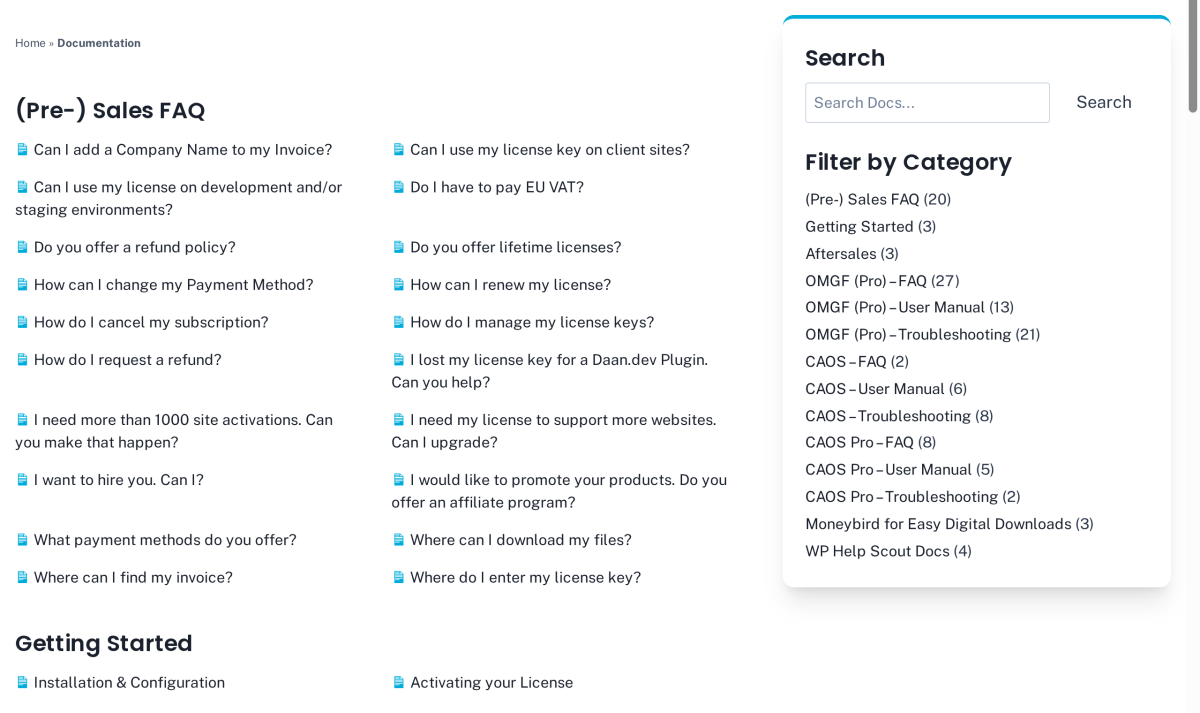
Your documentation page is a regular WordPress page with the Help Scout Docs Categories block on it. Choose a grid or a list, the number of columns, which articles to show and in which order, the icons and the colors. You see the result while you’re editing it.
And you only have to do it once. Your category pages and your search results automatically follow the design of your documentation page. No template overrides, no custom code. Change the block, and your entire documentation section changes along with it.
Or, design it your way

Prefer a page builder? WP Help Scout Docs comes with a widget for Elementor, and with Theme & Page Builder Support enabled you can design your documentation archive and articles in Elementor, Divi, Bricks or the Site Editor of your block theme.
Or, if you’d rather write PHP, use a template override in your (child) theme. Your docs, your rules.
Always up to date
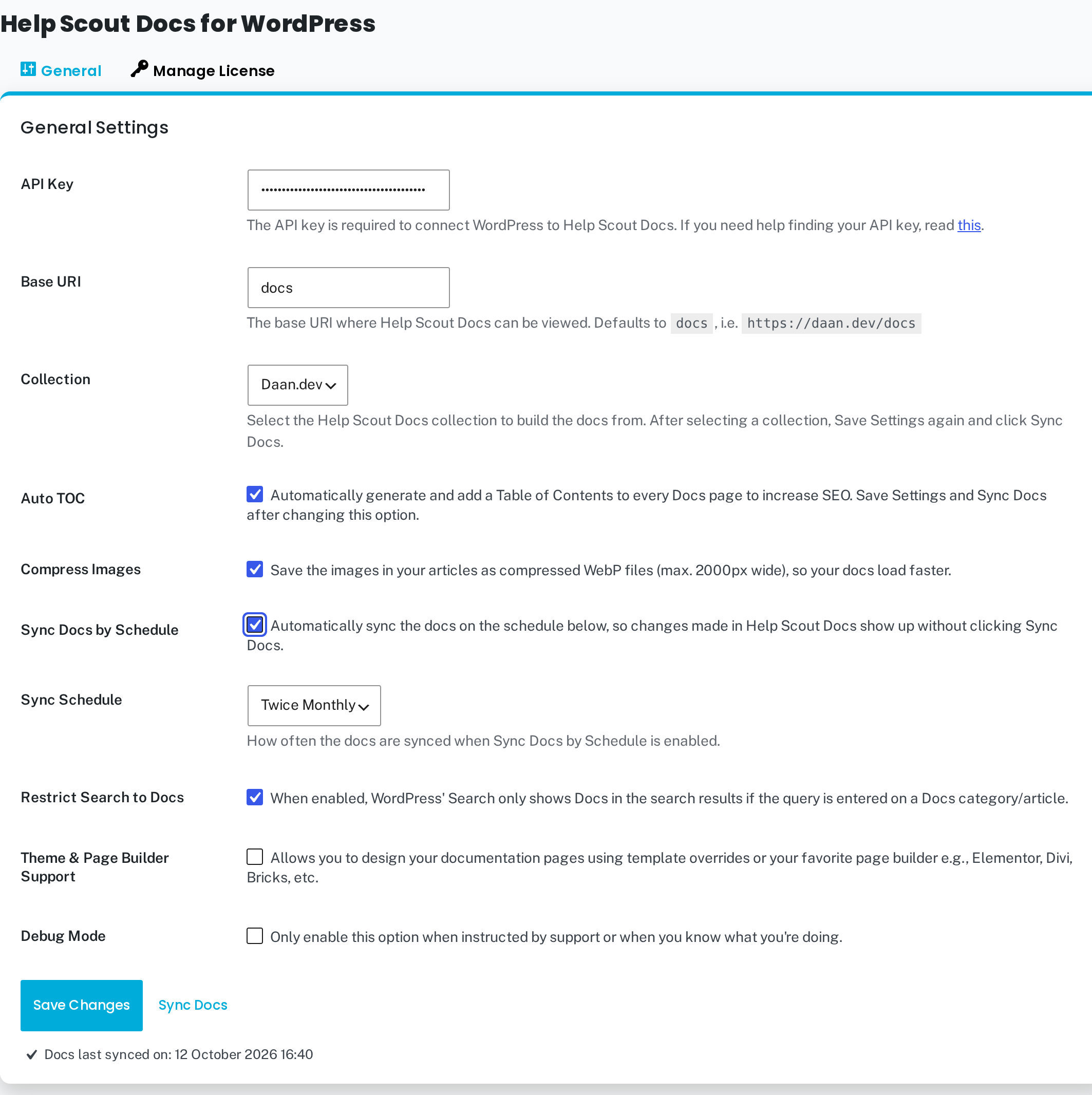
Changed an article in Help Scout? Click Sync Docs and it’s on your website. Or don’t click anything at all: with Sync Docs by Schedule enabled, your docs are synced automatically, from daily to monthly.
A sync never takes your documentation offline. Articles are updated in place, and only when they actually changed in Help Scout. Renamed an article? The old URL redirects (301) to the new one, so no broken links and no lost rankings. And if Help Scout can’t be reached for a moment, nothing is removed.
The little things
Because your docs are part of WordPress, a lot of things just work. Linking to an article from a blog post is as easy as linking to any other page. WordPress’ own search finds your articles, and with Restrict Search to Docs enabled, a search from your documentation only shows docs in the search results.
Long articles get a table of contents automatically, when you enable Auto TOC. It helps your readers find their way, and it helps your SEO too. Code blocks are converted to native Gutenberg code blocks, so your favorite syntax highlighting plugin picks them up.
And when you spot a typo while reading one of your articles, the Edit Article link in the admin bar takes you straight to it in Help Scout.
Set up in a few minutes
Paste your Help Scout API key, choose the collection you want to publish and where your documentation should live (/docs by default), and click Sync Docs. That’s all. Your Documentation page is created for you, with the block already on it.
See it in action
WP Help Scout Docs powers the documentation here on daan.dev, without any custom code. The overview, every category page and even the search results: all designed with a single block. Go ahead, have a look around!