
Local Fonts
Table of Contents
These settings affect the fonts OMGF (Pro) downloads and the generated stylesheet(s). Below the screenshot you’ll find a rundown of each option. Once you’re done configuring, you can simply click Save & Optimize.
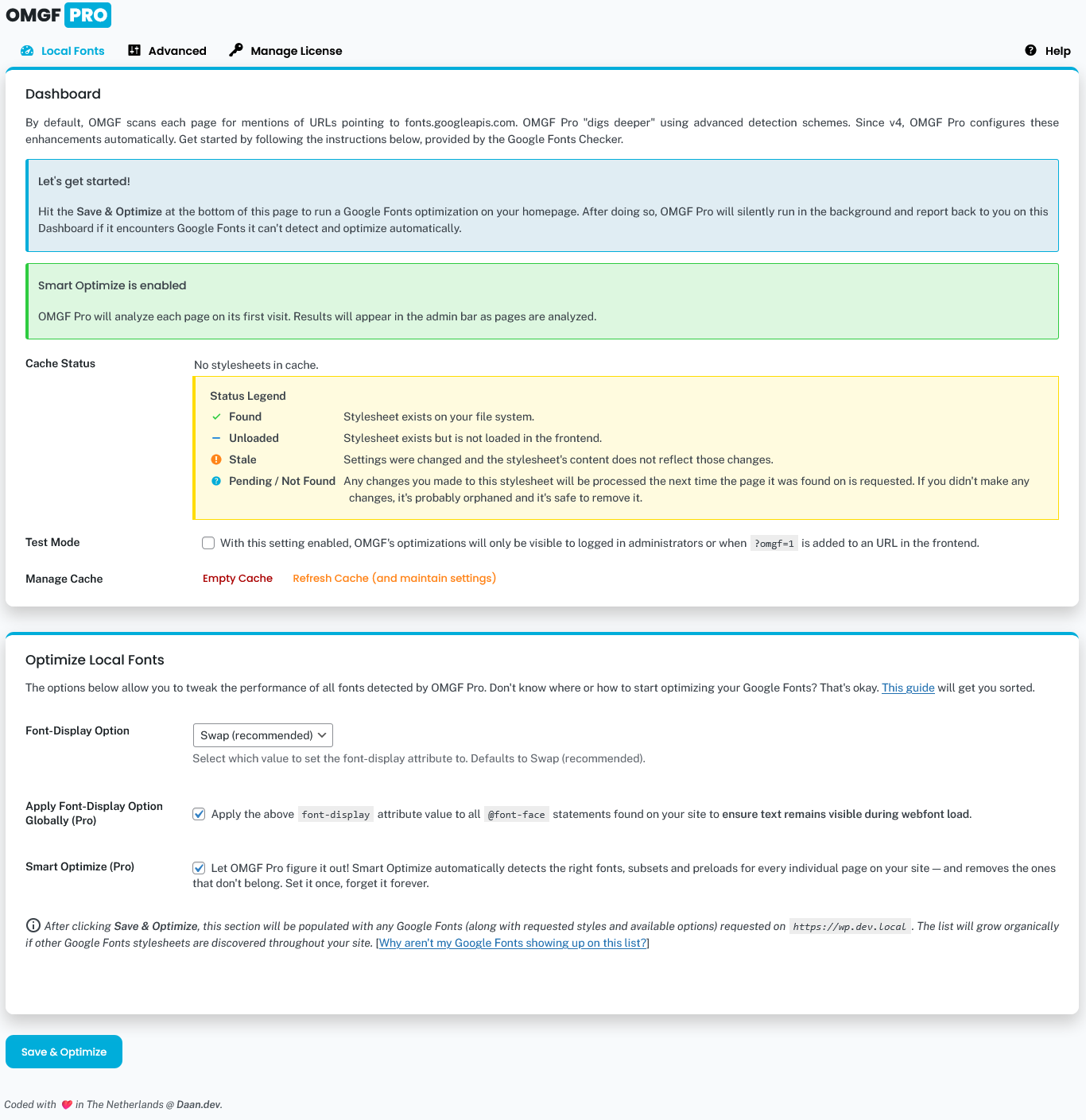
Dashboard
The dashboard offers a quick overview of cache status, detailed reports of performance and configurational issues and simple management tasks, like Configure, Remove, Empty/Refresh Cache Directory and Test Mode.
The colors of the info/notices boxes reflect the status of the stoplight in the Admin Bar.
On a fresh install you will see a blue box at the top:

After following the instructions, the ideal situation should look like this:

However, for several reasons, it’s possible that OMGF’s Performance checker runs into requests it can’t optimize. If so, OMGF (Pro) will notify you.
If, for whatever reason, OMGF (Pro) can’t detect any fonts on your website, it will urge to run a deeper inspection:

The dashboard might show a red alert box to warn you about detected Google Fonts it couldn’t process, e.g. due to exotic implementations, and provide steps on how to fix it:

When OMGF Pro is installed and active, the red alert is replaced with a yellow notice, prompting you to click the links to fix the issue automatically:

If a conflict with another plugin and/or theme is found, a separate box will list the found issues and provide links to documentation on how to fix it.

Performance Checker
Since v6.2, OMGF automatically checks how your fonts are performing throughout your website, and gives suggestions on how to resolve it. It also provides a link to the most affected page:

OMGF informs you about three levels of font performance:
- Subsets, if you’re using a multilanguage plugin and you configured OMGF to use multiple subsets.
- Unused Font-faces, if (some of) your pages are loading fonts that aren’t used.
- Missing Preloads, if (some of) your pages should preload some fonts to reduce your LCP score.
When OMGF Pro is installed and active, Smart Optimize (Pro) automatically optimizes your fonts’ performance on a per-page level.
Test Mode (default: off)
If you’d like to give OMGF (Pro) a test drive first, before deploying its optimizations to the public, enable this option. With this option enabled, OMGF (Pro)’s optimizations are only visible to logged in administrators and when ?omgf=1 is appended to the site’s URL.
Optimize Local Fonts
The optimize local fonts section groups all options related to optimization of Google Fonts detected by OMGF. These options allow you to tweak and improve the loading performance of your website’s fonts.
Font-display option (default: Swap)
Only change this if you know what you’re doing. In most situations ‘Swap’ is what you’re looking for, since it removes the Ensure text remains visible during webfont load optimization suggestion in Google PageSpeed Insights, effectively increasing your score.
Apply Font-display Option Globally (only available in OMGF Pro — default: off)
When this option is checked, OMGF Pro will parse all (CSS) stylesheets troughout your site’s frontend and make sure every @font-face statement includes a font-display: swap;value> attribute. <value> is replaced with the value of the Font-Display Option setting. Using this option will fix the Ensure text remains visible during webfont load optimization suggestion in Google PageSpeed Insights for all fonts, including FontAwesome, Elementor Icons, Elegant Icons and other icon packs.
Smart Optimize (Pro) (default: off)
When this option is checked, a small (~8KB) snippet of JS code will be loaded in the frontend every time a page is loaded for the first time.
Smart Optimize analyzes which fonts are used above-the-fold and aren’t used at all and automatically configures OMGF Pro to preload (i.e. load early) or remove the corresponding the font files. Removing unused fonts happens on a font-style/weight and unicode-range (i.e. subset) level to make sure each page’s fonts run at peak performance!
Limitations of Smart Optimize (Pro):
- It doesn’t run on 404-pages,
- If a unicode-range isn’t defined in the
@font-facestatement, the auto subsetting feature doesn’t work. Unused fonts will only be removed on a font-style and font-weight level.
Local Fonts
All Google Fonts are listed in the Optimize Local Fonts section of the settings screen. There you can choose to further tweak the performance of your locally hosted Google Fonts. An in-depth look on how to use it can be found here.
Done Optimizing?
After clicking Save & Optimize, OMGF (Pro) will immediately scan your homepage for Google Fonts and show an overview of found fonts. The Optimize Local Google Fonts overview will be shown (and adjusted) accordingly.